

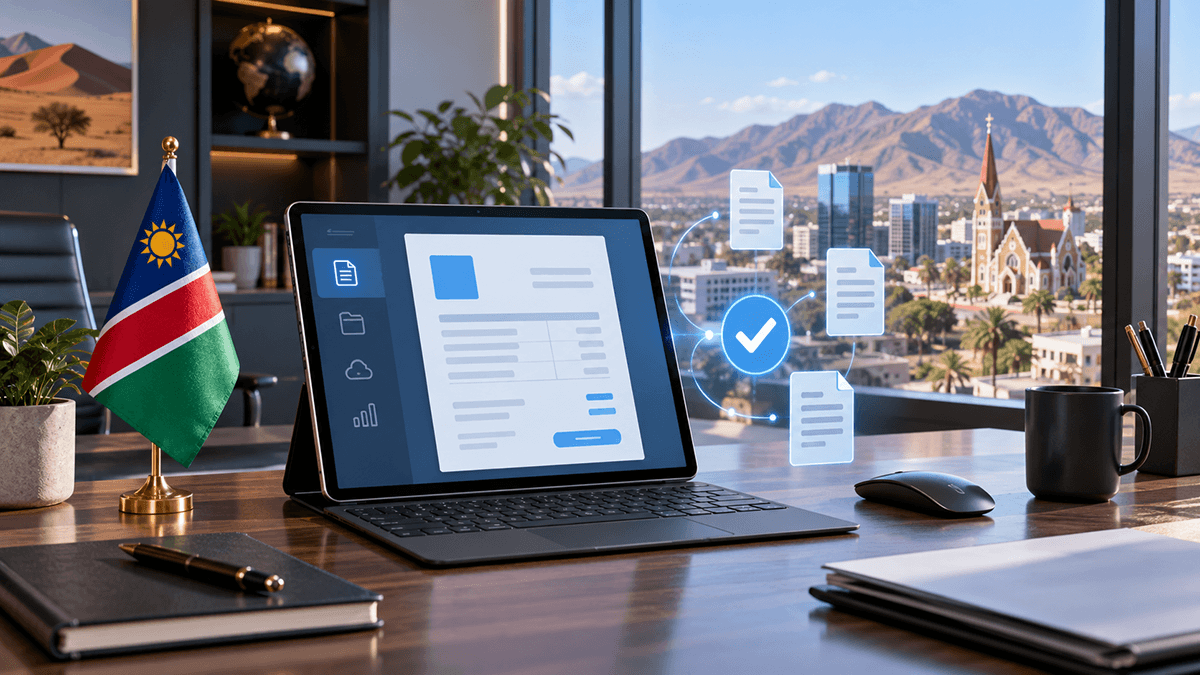
Electronic invoicing is becoming an increasingly important part of tax administration around the world, and Namibia is moving in the same direction.
The Namibian Government has confirmed its intention to modernise the country's VAT framework and introduce an e-invoicing system as part of wider tax administration reforms.
For businesses, this raises an obvious question: what does e-invoicing mean, and what should you be doing now?
What is e-invoicing?
E-invoicing is more than simply emailing a customer a PDF invoice.
In a formal tax e-invoicing system, invoice information is produced and exchanged electronically in a structured format. Depending on the model eventually adopted, certain information may also be transmitted to or validated by the tax authority.
The objective is to make transaction reporting more accurate, improve efficiency and strengthen VAT compliance.
For businesses, this generally means that accurate digital accounting records become increasingly important.
Where does Namibia currently stand?
Namibia's e-invoicing initiative has been under development for several years.
NamRA previously indicated that an e-invoicing system for VAT-registered persons was expected to roll out in April 2026. The stated objectives included reducing administrative costs, improving information accuracy and combating VAT fraud.
That timetable has since changed.
The Government's 2026/27 Budget Statement includes the modernisation of the VAT Act and implementation of e-invoicing among tax reforms planned during the 2026/27 to 2028/29 Medium-Term Expenditure Framework. The earlier fixed April 2026 implementation date is no longer given.
As of September 2026, businesses should therefore not treat e-invoicing as though a universal Namibian mandate is already in force. The initiative remains part of the Government's planned tax reforms, with implementation expected to develop over the medium term rather than through the previously proposed single April 2026 launch.
Businesses should watch future announcements from the Ministry of Finance and NamRA for confirmed technical requirements, implementation phases and effective dates.
Why is Namibia introducing e-invoicing?
From a tax administration perspective, digital invoicing can provide more accurate and timely information.
The Government's current budget specifically links the proposed changes to improved compliance, greater efficiency, fraud reduction and stronger revenue collection.
For compliant businesses, greater standardisation can also have practical benefits.
Well-implemented digital invoicing processes can reduce duplicate data entry, improve record keeping and make it easier to retrieve supporting documentation.
The key is having reliable accounting processes in place before new reporting requirements become mandatory.
Why businesses should prepare before a deadline is announced
It may be tempting to wait until formal implementation dates are published before doing anything.
However, businesses with poorly structured accounting records may have significantly more work to do when new requirements arrive.
Preparation does not necessarily mean purchasing new software today. It means making sure the financial foundation of the business is in good order.
Businesses can start by reviewing how invoices are currently generated, how customer and supplier information is maintained, how VAT is recorded and how supporting documentation is stored.
If invoices are created manually in Word or Excel and then entered separately into an accounting system, there may already be an opportunity to simplify the process.
Keep customer and supplier information accurate
Digital tax systems rely heavily on accurate data.
Businesses should therefore start paying closer attention to the quality of information in their accounting systems.
Customer and supplier records should be kept up to date, duplicate accounts should be corrected, and tax-related information should be recorded consistently.
This is good accounting practice regardless of e-invoicing, but it becomes even more important when information may eventually need to comply with a prescribed electronic format.
Review the way invoices are generated
A modern accounting system allows invoices to be generated directly from the accounting records rather than creating documents separately and capturing them again afterwards.
This reduces unnecessary duplication and helps ensure that the invoice presented to the customer agrees with the accounting entry.
Xero, for example, provides online invoicing as part of its cloud accounting platform.
However, businesses should not assume that using Xero — or any other accounting package — automatically guarantees compliance with Namibia's future e-invoicing requirements.
Those requirements will depend on the final legislation, technical specifications and integration arrangements introduced by NamRA.
Move away from unnecessary manual processes
One of the best ways to prepare for greater digitalisation is to identify areas where information is being captured repeatedly.
For example, an invoice might currently be prepared manually, emailed to a customer, entered into accounting software and then recorded again in a separate spreadsheet.
Every additional manual step creates another opportunity for errors.
Where practical, businesses should work toward having accounting information originate from a central, properly configured financial system.
Do not wait for compliance changes to improve your records
The introduction of e-invoicing should not be viewed purely as a tax compliance exercise.
It is also part of a broader shift toward more digital financial administration.
Businesses that maintain accurate, current accounting records are generally in a better position to produce reports, manage cash flow, follow up outstanding accounts and respond to future regulatory changes.
That makes preparing worthwhile even before e-invoicing becomes mandatory.
How Xilver Lining can help
Xilver Lining helps businesses review and improve their accounting processes, implement Xero and build efficient cloud-based financial systems.
As Namibia's e-invoicing framework develops, the most useful step businesses can take today is to make sure their underlying accounting information and processes are accurate, organised and increasingly digital.
Future technical requirements will become clearer as Government and NamRA release further guidance. A strong accounting foundation will make adapting to those changes considerably easier.